Why Grow Food? Four Reasons That Go Way Beyond the Harvest
Most of us grew up buying food in packages. That disconnect from where food comes from is newer than we think, and it costs us more than we realize. At Thunder Gardens, we partner with the Youth Services Bureau of Ottawa to run workshops for young people where seeds and soil are the teachers. These are the four principles we build everything around.
1. Connection to Nature
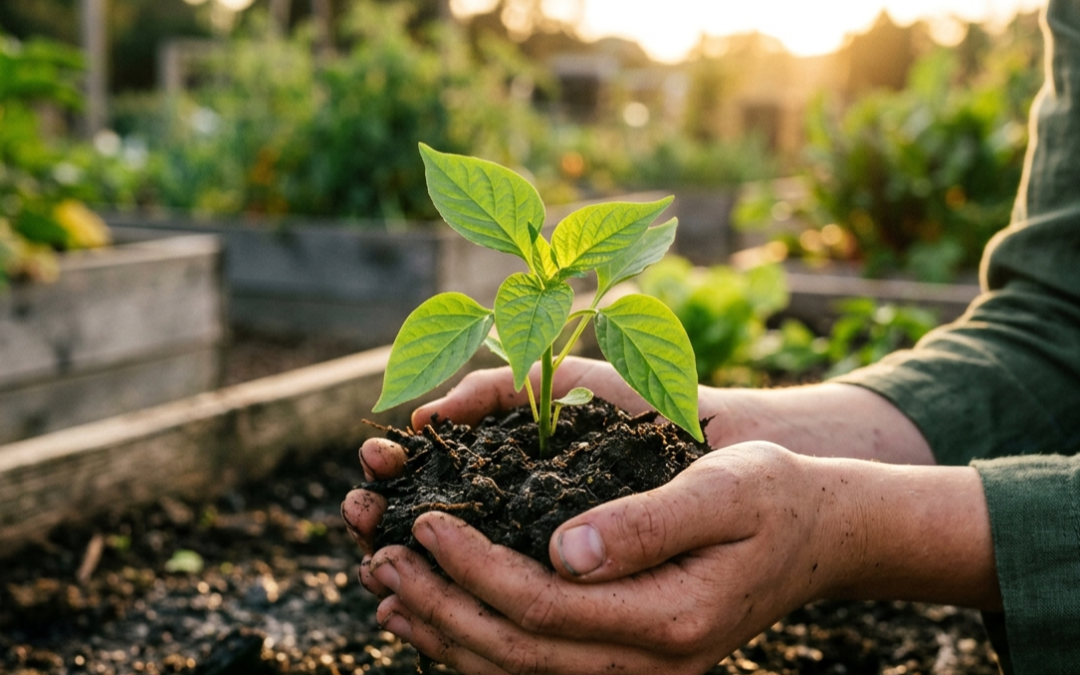
Growing a pepper from seed reconnects you to something real: soil, water, light, time. Nature operates on its own schedule, and when you tend a plant you become part of a living system that long predates anything we have built.
That reconnection is measurable. A study in the Journal of Health Psychology found that 30 minutes of gardening produced a significantly stronger drop in cortisol (the body's stress hormone) than indoor reading, and fully restored positive mood where reading did not. Read the study on PubMed.
Plants respond to how you show up today. That is a rare kind of fairness. Read about what showing up at Thunder Gardens actually looks like: What a Grow Together Shift Looks Like.
2. Resilience
Seeds fail to germinate. Pests arrive uninvited. A late frost takes a crop you worked to plant. And then you try again. That cycle of trying, adjusting, and continuing is the same one every person who has built something meaningful has lived through. The garden is one of the few places where that lesson arrives without judgement.
Research published in PLOS ONE found that people who gardened weekly during a high-stress period scored significantly higher on mental resilience measures than those who did not garden, with community gardening showing the strongest effect. Read the resilience research.
3. Personal Growth
Every time you check on your seedlings, you are practicing responsibility and follow-through. Small, consistent actions compound into something real. Growing food teaches you to read a situation, diagnose a problem, and act. Those are life skills. The garden is just where you practice them first.
This mirrors what psychologist Carol Dweck calls the growth mindset: the understanding that abilities develop through effort, not fixed talent. A paper in Frontiers in Psychology involving over 1,200 students found that a growth mindset predicted better wellbeing and school engagement, with resilience as the key mechanism. Explore the growth mindset research. A community farm accelerates all of this because you are learning alongside others. Start with our Beginner's Guide to Growing in Ottawa's Climate.
4. Mental Health
Research consistently shows that gardening reduces anxiety and depression, improves mood, and builds a sense of purpose. Even caring for a single seedling creates a daily reason to check on something that is counting on you.
Soil also contains a bacterium called Mycobacterium vaccae that activates serotonin pathways in the brain. Researchers at Bristol University found it triggers the same neural responses as many antidepressants. Getting your hands in the earth is, quite literally, good for your brain chemistry. Read the University of Colorado research.
"To plant a garden is to believe in tomorrow." — Audrey Hepburn
Grow With Us
A single container plant will teach you something real. A community farm amplifies everything. When you grow alongside others, the connection deepens, the resilience compounds, and the growth accelerates because you have people to learn from and with.
Thunder Gardens is a community farm in the Ottawa region open to all experience levels. Our 2026 season runs May through October. Spaces are limited.
Register for the 2026 season at Thunder Gardens →
Thunder Gardens is a community farm in the Ottawa region. We grow food, build skills, and create space for people to reconnect with the land and with each other. Learn more at thundergardens.ca.